Quick takes: Apple vs. Samsung

Round up of interesting opinions on last Friday’s decisive victory (see this comprehensive count-by-count summary in the Wall Street Journal) for Apple in the patent wars:
Unsurprisingly, Apple’s Tim Cook circulated a memo proclaiming that Today, values have won and I hope the whole world listens.” Samsung is working on appeals while messaging that this is a loss for the average consumer, and took a 6.9% beating in the market, the largest drop since October 2008.

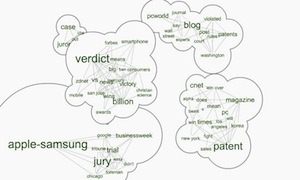
Graphic: Infomous-generated cloud of Apple Samsung topics in the news 08.26.2012

Is that social account legit?

The GSA announced the launch of an official registry of government social media accounts.  Their goals were to help users understand which accounts are legitimate in an era of phishing; offer a series of APIs for agencies to pull data back out of these burgeoning social accounts; and make the registry itself available to agencies, reducing duplication and error.

We launched a modest version of this directory idea at Harvard back in 2011 — a manually created directory of “official” social accounts at Harvard. Tweets had already been cleverly aggregated by David Malan and his CS50 crew, but there’s the problem of account creep and authentication. Is someone producing a HarvardTweet as a current faculty member or student? What happens when students graduate? When staff leave? How loose or tight should the definition of a HarvardTweet be?

Social media policies at most institutions address egregious misuse of accounts — sharing confidential information or harassment — but the question of affiliation is murkier, especially in an academic institution with 375,000 alumni worldwide. Perhaps the best approach is to divide into “endorsed” (departments, schools) versus “affiliated” (alumni, past and present staff) — and create useful APIs for both.

Down and out (of access) in Paris and London

Was lucky enough to get a little time away this summer — never enough — and sneak off to  London and Paris. Managed to avoid the Jubilee and the Olympics for the former, and all the Parisians (and, regrettably, their best boulangeries) for the latter.

It was eye-opening to me how much more digital and mobile London felt. Everything from finding location-aware Tube maps to evaluating museum passes to seeing what’s on around town at a glance on an iPad was easy and optimized for information on the go. Paris felt almost like the opposite — nothing seemed to render well for mobile and sites were organized more bureaucratically than with the user in mind.

End result: easier to find and buy via mobile in London. Wired cities may begin to see investment in digital as more than streamlining infrastructure and engaging citizenry in governance, but as a key to unlocking tourism dollars via mobile commerce.