Google+ today: From sausage fest to ghost town

Throughout 2011, it was clear that Google+ was mostly a male bastion. Mashable reported that if you were to throw a dart at Google+, it would be more than twice as likely to land on a man’s profile as a woman’s profile. Ensue hue and cry.

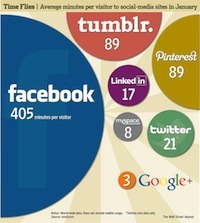
This week, the Wall Street Journal puts Google+ on ghost town watch, pointing out that users spend a mere three minutes a month on site versus six-seven hours on Facebook. Meanwhile, Pinterest is soaring, with growth driven largely by women. Think about it, guys.

Everything is a remix

We live in an age with daunting problems. We need the best ideas possible, we need them now, we need them to spread fast. The common good is a meme that was overwhelmed by intellectual property. It needs to spread again. If the meme prospers, our laws, our norms, our society, they all transform.

That’s social evolution and it’s not up to governments or corporations or lawyers… it’s up to us.

Everything is a remix [web video series]

Brand democracy is not brand anarchy.

Just read The Role of Brand in the Nonprofit Sector which pointed to the emerging acceptance of brand as strategic asset that goes beyond tactical fundraising tool.

There’s an interesting tension between the rise of individual voices through social media, and a dated perception that messaging hierarchies mandate institutional lockstep. This is definitely a  top  FAQ: “why bother with any kind of communications coordination in the age of social media?” For me, the answer is that social presents an opportunity to reinvigorate brand messaging – to listen and to reach out to constituents (be they employees, supporters, alumni) to understand more about your brand’s resonance — and then to use that understanding to craft messages that stick.

The authors said it best: democracy != anarchy. Working with nonprofit brands serves up an opportunity to learn and engage with social to refine brand positioning.

What new leadership looks like

Last week I was lucky to hear two fascinating talks: from Bill George, HBS prof and author of True North, and Wael Ghonim, the Google employee and internet activist who energized pro-democracy demonstrations in Egypt just over a year ago.

The theme that emerged for me was distributed leadership. George spoke about IBM’s collaborative organizational structure and shifting definition of leadership. In a workforce of 440,000 employees, he described IBM as cultivating 40,000 of them for some kind of leadership role. Ghonim focused on current and future challenges for Egypt and pointed to the importance of the many “ordinary” young Egyptians in the uprising — while disavowing narratives that position him as the movement’s hierarchical leader. (Good NPR review of his book, Revolution 2.)

The point about the death of command-and-control and emergence of new, global organizational models is not a new one. What was striking to me was two such different men with vastly different life experiences, both underscoring the imperative of reaching that conclusion.
From SOPA to Susan G. Komen to Superbowl

Hard to believe that in fewer than three weeks, social media has been front and center on three major news headlines: the SOPA defeat, the Susan G. Komen (apparent) reversal on Planned Parenthood, and tonight’s Superbowl. The first two events mark social’s expanding role in leading and shaping public opinion; the Superbowl stands out as the moment when social was self evident enough that TV ads featured hashtags with no explanation. (I can remember being asked to provide explanatory copy for ads featuring the cryptic “www.lotus.com”  back in 1997.)

We’ve come a long way from 2007 when tech pundits saw Twitter as “stupid and lame and small …  [and] real addictive